
One of the biggest questions many people quietly wrestle with after reading the Bible is this:
Some people ask it silently.
Others debate it publicly.
Some avoid the conversation completely.
But the question never really disappears.
Why does God seem so different between the Old Testament and the New Testament?

Why does God seem so different between the Old Testament and the New Testament?
In one part of the Bible, God sends judgment, commands wars, destroys cities, and gives strict laws with severe consequences.
Then suddenly in the New Testament, the message appears softer, calmer, more forgiving, more focused on love, grace, mercy, and salvation.
To many readers, especially first time readers, it can honestly feel like two completely different personalities.
Some people even reach the point of asking whether the Bible is truly describing the same God at all.
It is a question that has existed for centuries.
Scholars have debated it.
Religious leaders have debated it.
Ordinary readers still debate it today.
And regardless of someone’s religious position, the contrast is impossible to ignore.
The Old Testament Often Feels Intense
Sometimes brutally intense.
For many readers, this is where the struggle begins.
The language feels heavy.
The punishments feel immediate.
The fear feels real.
When people talk about the Old Testament, several stories immediately come to mind.
The destruction of Sodom and Gomorrah.
The great flood in the days of Noah.
The plagues of Egypt.
The strict laws given to Israel.
Punishments for disobedience.
Wars and judgments.
Many readers encounter these stories and wonder:
Why is God so harsh here?
The tone can feel heavy.
The consequences can feel severe.
The laws can appear overwhelming.
There are moments where entire nations face judgment.
There are stories where one act of disobedience leads to immediate punishment.
There are passages centered around fear, holiness, sacrifice, obedience, and justice.
To modern readers, especially younger generations, this can feel difficult to process.
People naturally compare that image with the teachings of Jesus in the New Testament.
Love your enemies.
Forgive others.
Turn the other cheek.
Blessed are the merciful.
The emotional difference between the two sections feels enormous.
The New Testament Feels More Personal
Then suddenly, the atmosphere changes.
The stories feel closer.
More emotional.
More human.
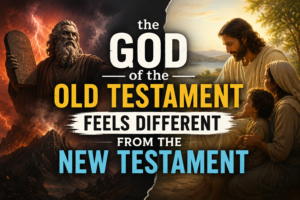
The New Testament introduces Jesus Christ, and through him the tone of the Bible changes dramatically.
Instead of focusing mainly on nations, kings, wars, and law, the focus becomes deeply personal.
Forgiveness.
Compassion.
Healing.
Mercy.
Redemption.
Hope.
Jesus spends time with ordinary people.
The poor.
The rejected.
The sick.
Tax collectors.
Sinners.
He teaches through parables.
He heals the blind.
He comforts people.
He speaks about loving others.
For many readers, this version of God feels easier to connect with emotionally.
Instead of fear, people notice grace.
Instead of judgment, people notice forgiveness.
Instead of destruction, people notice sacrifice.
And this naturally creates a major question:
If God never changes, why does the Bible feel so different between these two eras?
Context matters more than many people realize
One important thing often overlooked is the historical context of the Bible.
The Old Testament covers thousands of years of ancient history.
It was written in a world filled with:
Violence
Empire building
Tribal conflicts
Harsh survival conditions
Ancient legal systems
Constant warfare
The societies described in those texts were very different from modern life.
At the time, strict laws were often connected to survival, identity, and order.
The nation of Israel was trying to survive among powerful neighboring nations.
Their laws shaped their identity.
Their covenant with God shaped their culture.
In that setting, justice and obedience were emphasized heavily.
Meanwhile, the New Testament takes place during Roman occupation and shifts focus toward spiritual transformation and individual salvation.
The setting changes.
The audience changes.
The emphasis changes.
Some believers argue that this explains much of the tonal difference.
Justice Versus Mercy
This is where many debates begin.
Justice.
Mercy.
Punishment.
Forgiveness.
Can all these things truly exist together?
Another common explanation is that both Testaments reveal different aspects of the same God.
The Old Testament strongly emphasizes justice.
The New Testament strongly emphasizes mercy.
But even this distinction is not perfectly simple.
Because mercy also exists in the Old Testament.
God spares Nineveh after repentance.
David receives mercy multiple times.
God repeatedly forgives Israel despite continual disobedience.
At the same time, judgment also exists in the New Testament.
Jesus speaks about hell.
He overturns tables in the temple.
The book of Revelation contains scenes of judgment and destruction.
So the idea that one Testament is only wrath while the other is only love is not entirely accurate.
Both themes appear in both sections.
The difference is more about emphasis and presentation.
Jesus changed how people viewed God
One major reason the New Testament feels different is because of Jesus himself.
For Christians, Jesus becomes the clearest image of God’s character.
His actions shape how believers understand love, forgiveness, humility, sacrifice, and compassion.
He speaks directly to human pain.
He interacts personally with suffering.
He teaches people to forgive.
This creates a stronger emotional connection for many readers.
The Old Testament often speaks on a national scale.
The New Testament often speaks on a human scale.
That emotional closeness changes the reading experience dramatically.
Some People Believe The Bible Evolved Over Time
Not everyone reads scripture the same way.
And that difference in perspective changes everything.
Not everyone approaches the Bible from the same perspective.
Some scholars and readers believe the Bible reflects evolving human understanding of God over centuries.
According to this view, ancient writers understood God differently from later writers.
As societies changed, spiritual understanding changed too.
This perspective suggests that the image of God became more compassionate and universal over time.
Traditional believers usually disagree with this idea because they believe the Bible is divinely inspired and consistent in its core message.
Still, the discussion continues today in churches, universities, online forums, and private conversations.
Why this question matters to many readers
This is not just a theological debate.
For many people, it becomes deeply personal.
People ask:
How should I view God?
Should I fear God?
Should I trust God?
Why does suffering exist?
Why does judgment exist?
Can love and justice truly coexist?
These questions affect faith, morality, spirituality, and personal identity.
Some people become stronger in faith after studying these differences.
Others become more skeptical.
Others remain undecided for years.
And honestly, many believers themselves continue wrestling with these questions throughout their lives.
Difficult passages still challenge believers today
Even committed Christians sometimes struggle with certain Old Testament passages.
Stories involving violence, destruction, and severe punishments continue to raise moral and emotional questions.
Pastors, theologians, and scholars have written countless books trying to explain these passages.
Some focus on historical context.
Some focus on symbolism.
Some focus on divine justice.
Some argue certain passages are misunderstood.
There is no single explanation that satisfies everyone.
And because of that, discussions around the character of God remain active today.
The Bible itself says God does not change
An interesting detail is that the Bible itself repeatedly claims that God is unchanging.
Yet readers still perceive major differences between the Testaments.
This creates one of the central tensions within biblical interpretation.
Some Christians explain this by saying God’s character never changed, but humanity’s relationship with God changed.
Others say the New Testament reveals God more fully.
Others believe human authors emphasized different attributes depending on their historical situations.
The interpretation often depends on personal belief, denomination, culture, and life experience.
Modern readers often focus more on compassion
Today’s world tends to value empathy, inclusion, compassion, and emotional understanding very strongly.
Because of that, many modern readers naturally connect more easily with the New Testament.
Teachings about forgiveness and love feel more relatable.
Meanwhile, ancient judgment narratives can feel uncomfortable or difficult to reconcile with modern ethics.
This difference in cultural mindset also affects how people interpret scripture today.
The Internet Has Made These Discussions Even Bigger
Today, conversations about faith spread faster than ever before.
In previous generations, these conversations mostly happened inside churches, seminaries, or religious circles.
Today, millions of people discuss these topics openly online.
Social media.
YouTube debates.
Podcasts.
Blogs.
Forums.
TikTok discussions.
People now encounter many viewpoints quickly.
Some defend traditional interpretations passionately.
Some criticize religion entirely.
Some simply ask honest questions while searching for understanding.
This openness has made biblical discussions more accessible than ever.
Questioning does not automatically mean rejection
One important thing many people misunderstand is this:
Asking difficult questions about faith does not automatically mean someone lacks faith.
Throughout history, many religious thinkers wrestled deeply with difficult questions.
Questioning can come from curiosity.
It can come from pain.
It can come from sincere desire for truth.
For many people, faith becomes stronger after honest exploration.
For others, questioning leads them in completely different directions.
Either way, these conversations are part of how humans seek meaning and understanding.
Can both versions exist together?
Perhaps the biggest challenge for readers is trying to reconcile justice and love together.
Can a God of judgment also be a God of mercy?
Can holiness and compassion coexist?
Can punishment and forgiveness exist within the same character?
Different religions and denominations answer these questions differently.
Some emphasize God’s holiness.
Some emphasize love.
Some focus on balance between the two.
And this is why the conversation continues generation after generation.
Final Thoughts
No matter where someone stands spiritually, this discussion continues to shape how millions of people view faith, religion, morality, and the idea of God itself.
The difference between the Old Testament and New Testament portrayal of God is one of the most discussed topics in biblical history.
To some readers, the contrast feels understandable once context is considered.
To others, the contrast still feels too large to ignore.
Some see consistency.
Some see development.
Some see contradiction.
But almost everyone who seriously reads the Bible eventually notices the shift in tone.
And perhaps that is why the discussion never truly disappears.
The question touches something deeper than theology alone.
It touches justice.
Love.
Fear.
Mercy.
Human suffering.
Hope.
Meaning.
Whether someone approaches the Bible as a believer, skeptic, student, or simply a curious reader, the conversation surrounding the nature of God in the Old and New Testament remains one of the most fascinating discussions in religious history.